
.png)
In this series of articles, discover various professions you can find in Luxembourg.
The role of an educator
The profession of educator involves supporting individuals (children, adolescents, adults or seniors) in their development, autonomy and social integration. It is a job where empathy meets pedagogy. An educator designs projects, supports people facing difficulties and promotes well-being within the community.
A true pillar of social connection, he observes, listens, guides and intervenes to ensure a safe and enriching environment. But his role goes beyond supervision, as he acts as a mediator between the individual, their family and institutions, offering tailored educational solutions to meet specific needs (disabilities, social vulnerability, early childhood, etc.).
Whether working in childcare facilities (Maisons Relais, nurseries), specialised centres or the social services sector, the educator draws on a combination of human, psychological and organisational skills. His commitment and care contribute to societal balance and to the successful life journey of those he supports.
The responsibilities of an educator:
- Design and implement educational and pedagogical projects;
- Support beneficiaries in their daily life activities;
- Lead developmental, recreational or socio-educational activities;
- Observe behavioural changes and prepare progress reports;
- Ensure the physical and emotional safety of those in their care;
- Collaborate with families and institutional partners;
- Promote autonomy and social inclusion for vulnerable individuals;
- Manage conflict or crises through mediation.
Education and skills
There are several training routes leading to the educator profession:
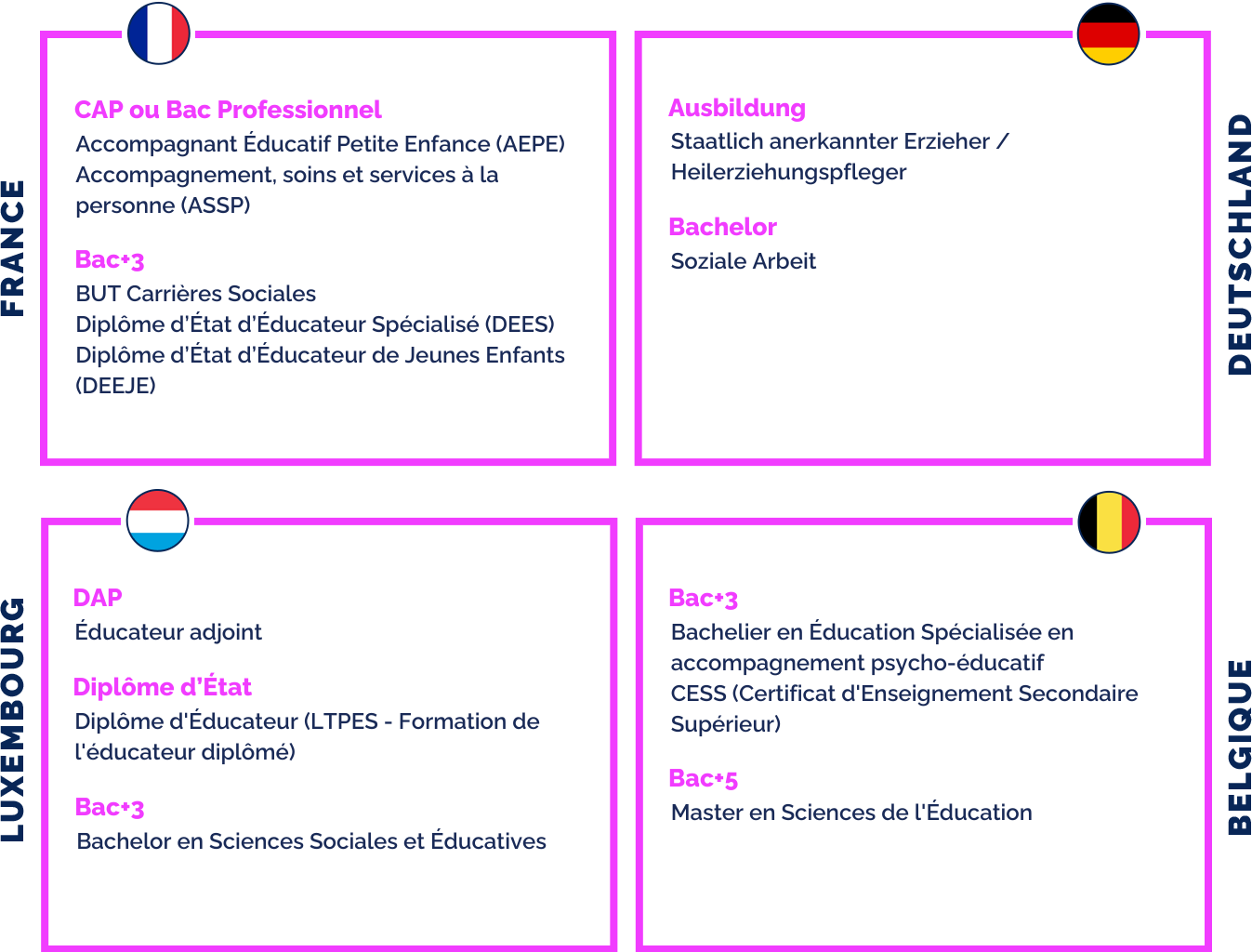
Table showing French, German, Luxembourg and Belgian qualification levels for the educator profession in Luxembourg
These academic programmes provide a strong foundation in psychology, sociology and pedagogy, while allowing for specialisation according to the target group (early childhood, disabilities, social integration). In Luxembourg, continuing education and specialisations (systemic approaches, autism, residential management) are highly encouraged for career advancement.
Additionally, if your diploma was obtained outside Luxembourg, it is mandatory to apply for recognition of equivalence to practise in the country. This process can be completed via guichet.lu.
These training courses enable participants to acquire the skills essential for this profession:
- Empathy and active listening: understanding unspoken needs and building trust;
- Observation skills: analysing group dynamics and individual needs;
- Emotional stability: knowing how to manage stress and remain calm in difficult situations;
- Organisation: planning activities and handling administrative follow-ups;
- Teamwork: communicating with colleagues and experts (psychologists, social workers) to ensure consistent follow-up;
- Ethical awareness: respecting professional ethics, professional secrecy and individual rights;
- Adaptability: adjusting pedagogical approaches to suit each situation or audience.
The different types of educators
Early childhood educator (ECE):
- Works mainly in nurseries and school childcare centres;
- Encourages early learning and socialisation through play and educational activities.
Specialised educator:
- Supports individuals facing difficulties (disabilities, behavioural disorders, social vulnerability);
- Assists with reintegration and social autonomy.
Graduated educator (with a Bachelor’s degree):
- Combines direct intervention with project coordination and team management;
- Often holds positions of responsibility within social structures or government services.
Being an educator in Luxembourg
Educators are in high demand in Luxembourg due to the continual expansion of childcare facilities (Maisons Relais, nurseries) and growing social needs.
Multilingualism is central to the profession. Educators often switch between Luxembourgish (essential for early childhood development and local communication), French, German and sometimes Portuguese or English to communicate with families from immigrant backgrounds. Mastery of the official languages is a major advantage for career progression and understanding the country’s socio-cultural context.
Salaries for educators in Luxembourg vary depending on qualifications (DAP, state diploma or Bachelor’s degree), experience and the applicable collective agreement (usually the SAS agreement in Luxembourg):
- Qualified educator (entry-level): between €3,400 and €4,200 gross per month;
- Graduated educator (Bachelor, entry-level): between €4,500 and €5,200 gross per month;
- With experience and seniority, salaries can reach €6,500 to €7,500 at the end of their career for a graduate educator under a state or collective agreement contract.
Career prospects
Educators can progress to positions such as:
- Director of a childcare facility (Maisons Relais, nurseries);
- Coordinator of socio-educational projects;
- Trainer or mentor for interns;
- Specialist in a specific field (youth protection, family mediation).
Did you know?
Luxembourg has a unique system of childcare service vouchers (CSA) that finances a large portion of facilities where educators work. This has created a sustained demand for qualified professionals over the past decade, making the country one of the most dynamic employers in Europe for this sector.
Fun fact: in some Luxembourgish Maisons Relais, it’s not uncommon for a children’s song to start in Luxembourgish, continue in French and end with an English word. Luxembourgish educators are true linguistic chameleons who help children become future citizens of the world!
Discover all the educator jobs in Luxembourg on Moovijob.com.
If you would like to find out more about careers in Luxembourg, visit our blog.