
.png)
The city of Luxembourg is brimming with job opportunities and businesses of all kinds, but which are the main business districts of the capital?
Kirchberg, the main business district
When people talk about a "business" district, Kirchberg invariably comes first. It is recognisable by its tall, modern buildings, separated by a vast boulevard stretching 3.5 km in length. The district covers a large area but has a relatively low population density. Its concentration of jobs, however, is very high.
In 2020, the district was home to around 3,500 residents for 44,000 jobs. There are therefore more than ten times as many workers as residents in Kirchberg, making it Luxembourg’s leading business district.
The city’s objective, however, is to make it a more pleasant place to live by increasing the number of residents faster than the number of jobs. It is forecasting a 243% increase in inhabitants compared with only a 34% rise in jobs by 2035. Major property developments are planned to encourage more people to live in the district, which is currently populated mainly by young professionals who work locally.
The City of Luxembourg would like to create more pedestrian areas and attract shops beyond the John Fitzgerald Kennedy Boulevard, and therefore further away from office buildings. Sports and cultural facilities such as the Philharmonie, the MUDAM and the Coque also help to attract people to the district, even outside working hours.
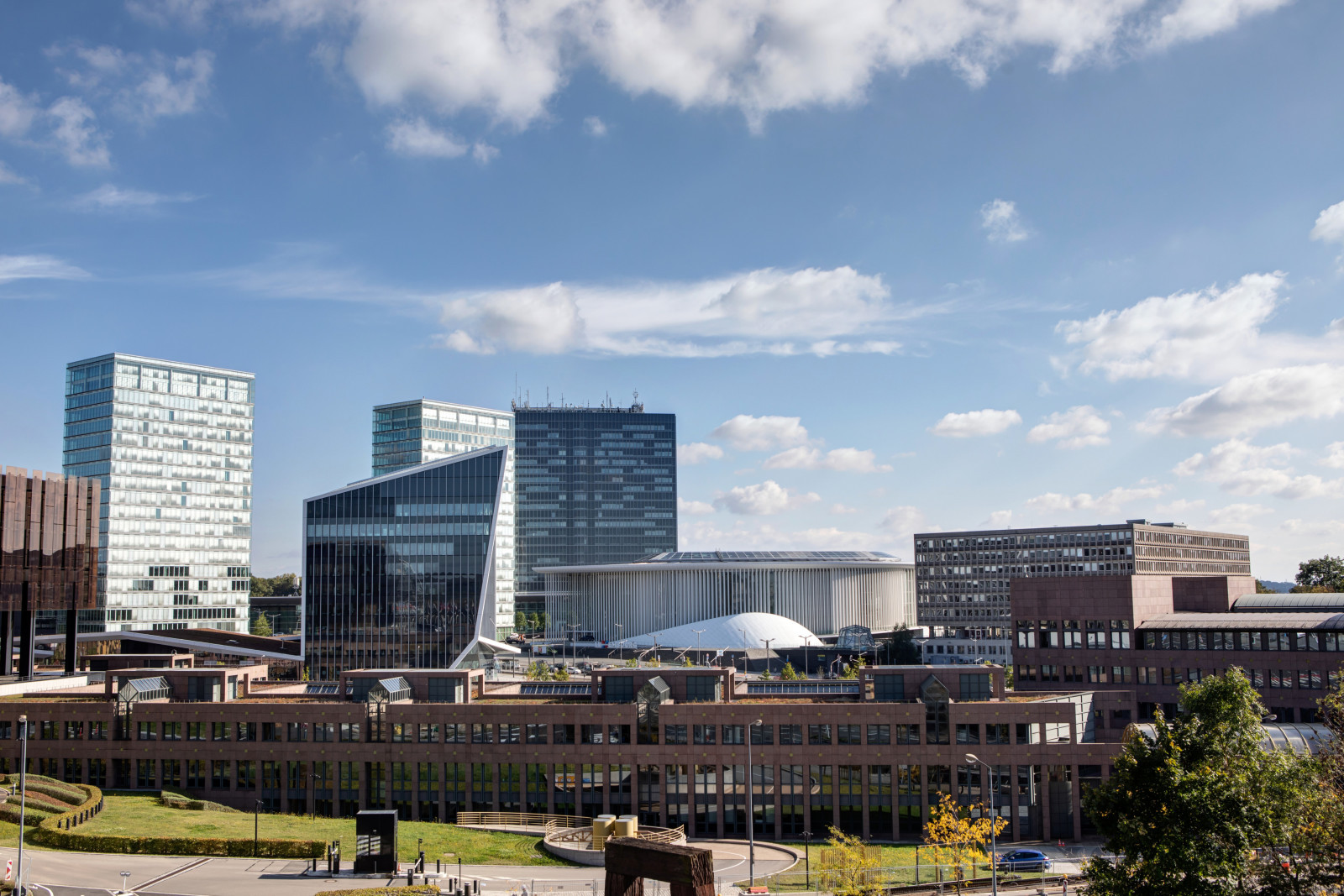
Kirchberg © Luxembourg City Tourist Office
La Cloche d’Or, the thriving new business hub
Located in the south of the capital, La Cloche d’Or has established itself as one of Luxembourg's most dynamic business districts, designed to blend professional, residential and commercial life. Since the arrival of major companies such as PwC, Deloitte, Alter Domus and State Street, the district has been attracting more and more headquarters and modern offices, with over 120,000 m² of office space already delivered and many more projects underway.
Today, more than 20,000 people live, work or visit La Cloche d’Or daily, and this number is expected to exceed 30,000 by 2030.
Planned as a mixed-use district, La Cloche d’Or combines employment, housing, retail and green spaces, particularly around the Parc de la Cloche d’Or. With excellent tram, bus and motorway connections, it appeals to companies seeking a modern, accessible and enjoyable environment.
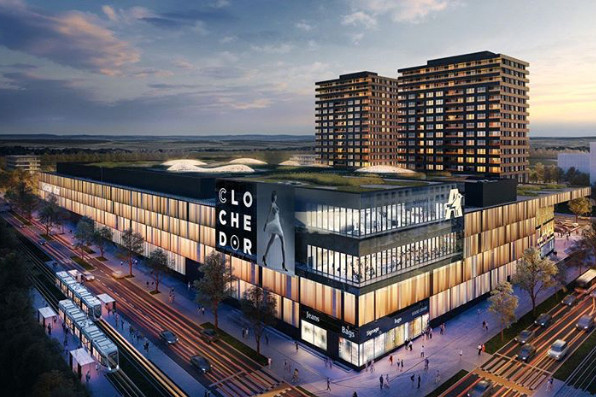
Cloche D'or district © Auchan Cloche D'or
The Gare (train station) district
A major transit hub (with 90,000 daily journeys in 2023, according to CFL), Luxembourg Central Station is the nerve centre of the country’s transport network. Trains, trams and buses from across the country all converge here, making it a strategically attractive location for businesses. In 2020, the district had approximately 11,000 residents and 22,000 jobs, nearly twice as many jobs as residents. The Gare district is lively and constantly on the move, sitting at the crossroads of transport users, workers, residents and customers of its many shops.
The Gare district lies at the very heart of employment in Luxembourg. In fact, it is home to the offices of Moovijob.com! 😉
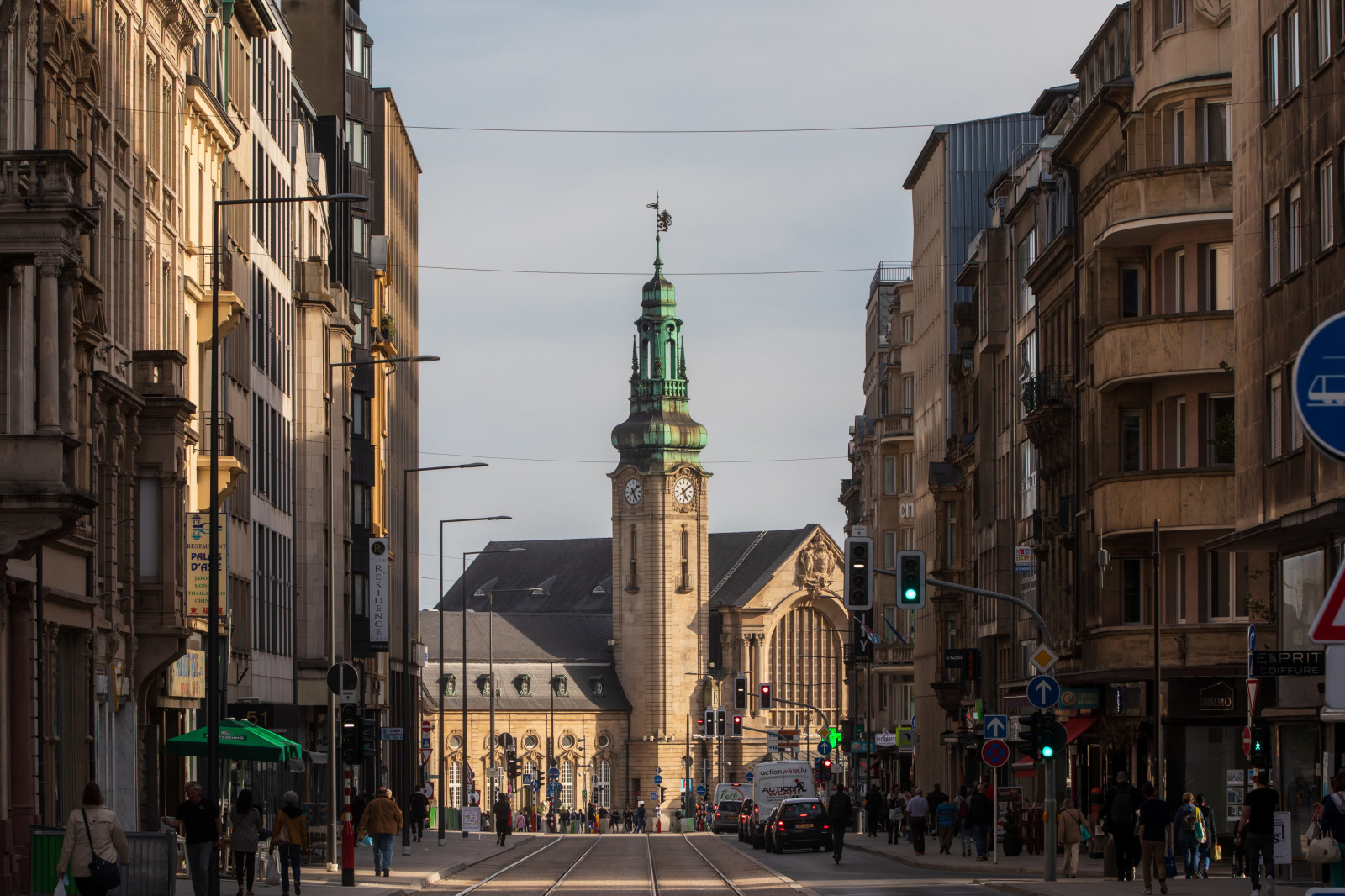
Luxembourg Station © Luxembourg City Tourist Office
Ville Haute, the heart of Luxembourg
The Ville Haute, located right in the centre of the capital, is the city’s historic district. It concentrates a large number of jobs despite having a relatively small number of residents. There is not much housing in the area and property prices are therefore rather high. In 2020, the district had 27,081 jobs for 3,444 inhabitants. The city is planning an increase of 16% in residents and 9% in jobs by 2035.
Most jobs located in the city centre are linked to the retail sector. The many shops and restaurants bring the district to life and make it an essential thoroughfare for Luxembourgers and cross-border commuters looking to go shopping.
Some company offices are nevertheless located in the Upper Town. However, it is difficult to describe it as a true "business district", as the concentration of offices is far lower than in neighbouring areas such as Kirchberg and the Gare.
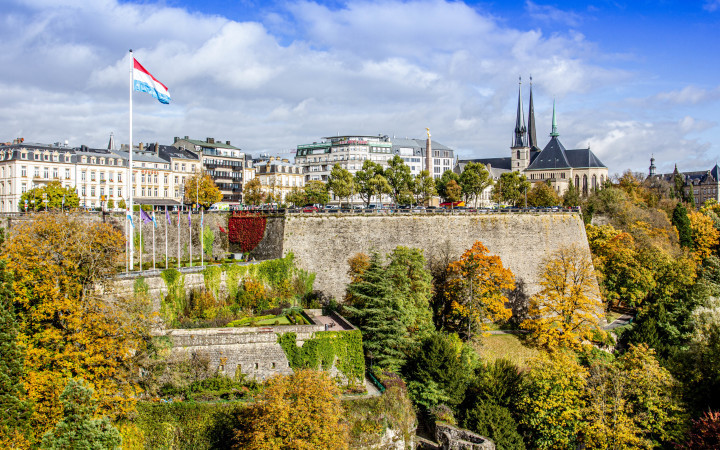
La Ville Haute © Luxembourg City Tourist Office
Districts set to change the most by 2035
The City of Luxembourg has drawn up forecasts for changes in population and employment by 2035, making it possible to identify the districts most likely to transform.
In addition to Kirchberg, the Neudorf / Weimershof district is expected to follow its neighbour’s development path. However, in contrast, it is mainly the number of jobs that will increase. The city is forecasting a 49% rise in inhabitants compared with an 88% increase in jobs. As Neudorf lies right next to Kirchberg and its many office buildings, it is logical to assume that companies will move in. Development of the area will notably include the construction of a footbridge between the Cents and Kirchberg districts (with Neudorf located between the two) by 2028. This will facilitate active mobility in the area and improve interconnections between districts, making them more attractive.
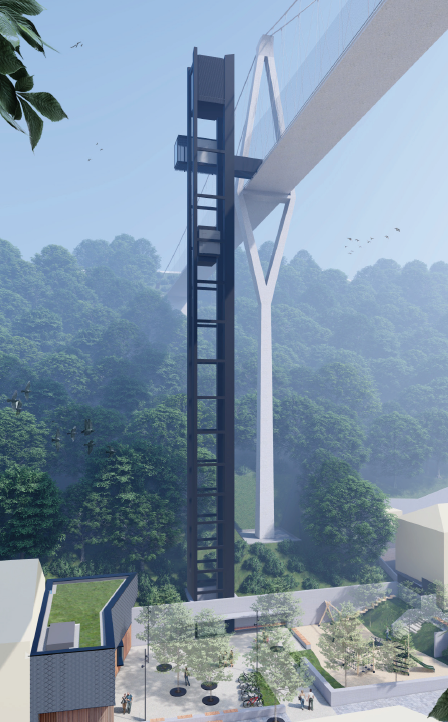
Lift project for the footbridge © City of Luxembourg
The Hollerich district is also expected to see significant development in the coming years. The city anticipates that its population will double and that the number of jobs will increase by 71%. This coincides with the "Nei Hollerich" project, which aims to create a complete district featuring housing, shops and public spaces such as a park. The government wants to make it a "fully-fledged living and working district", which will also be supported by the arrival of the tram. Located close to the station and Ville Haute, Hollerich could prove highly attractive to companies considering setting up there.
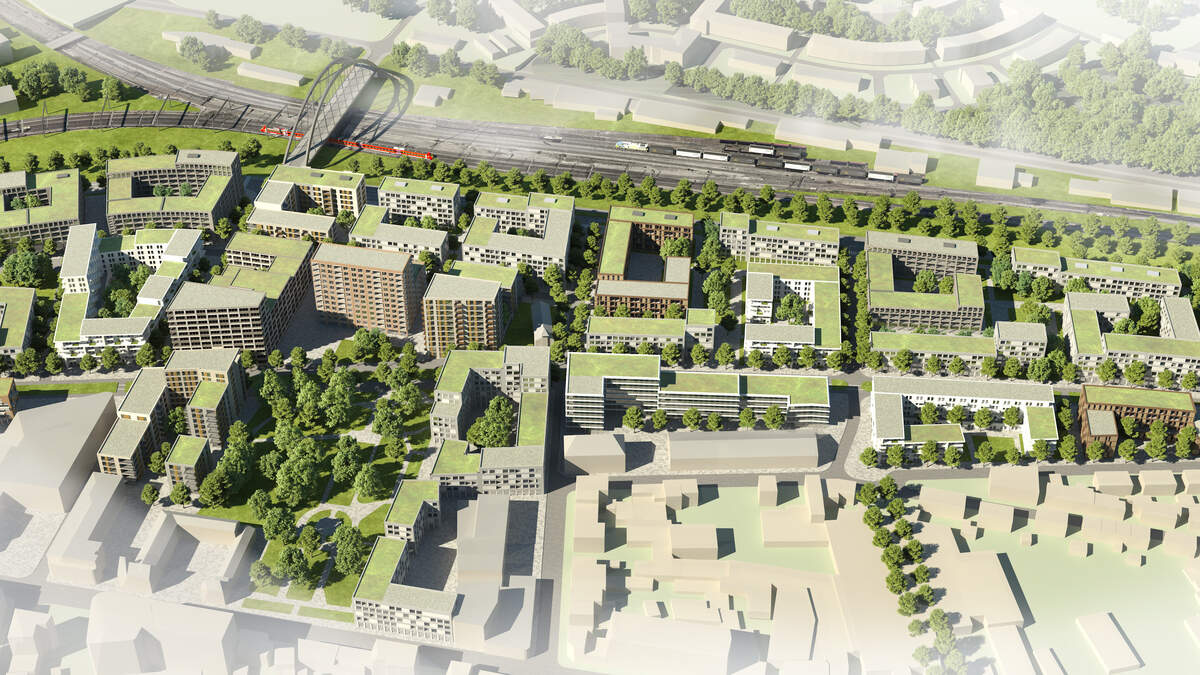
The future Nei Hollerich district © GIE Nei Hollerich
Next to Hollerich, the Cessange district is also likely to change considerably over the next ten years. It is a fairly quiet residential area, with its quality of life rated at 94/100 by residents. The City of Luxembourg is forecasting a doubling of the population within ten years, along with the creation of nearly 2,000 jobs. As in Hollerich, the tram will be introduced, further improving mobility and transforming the area into more than just a residential district.
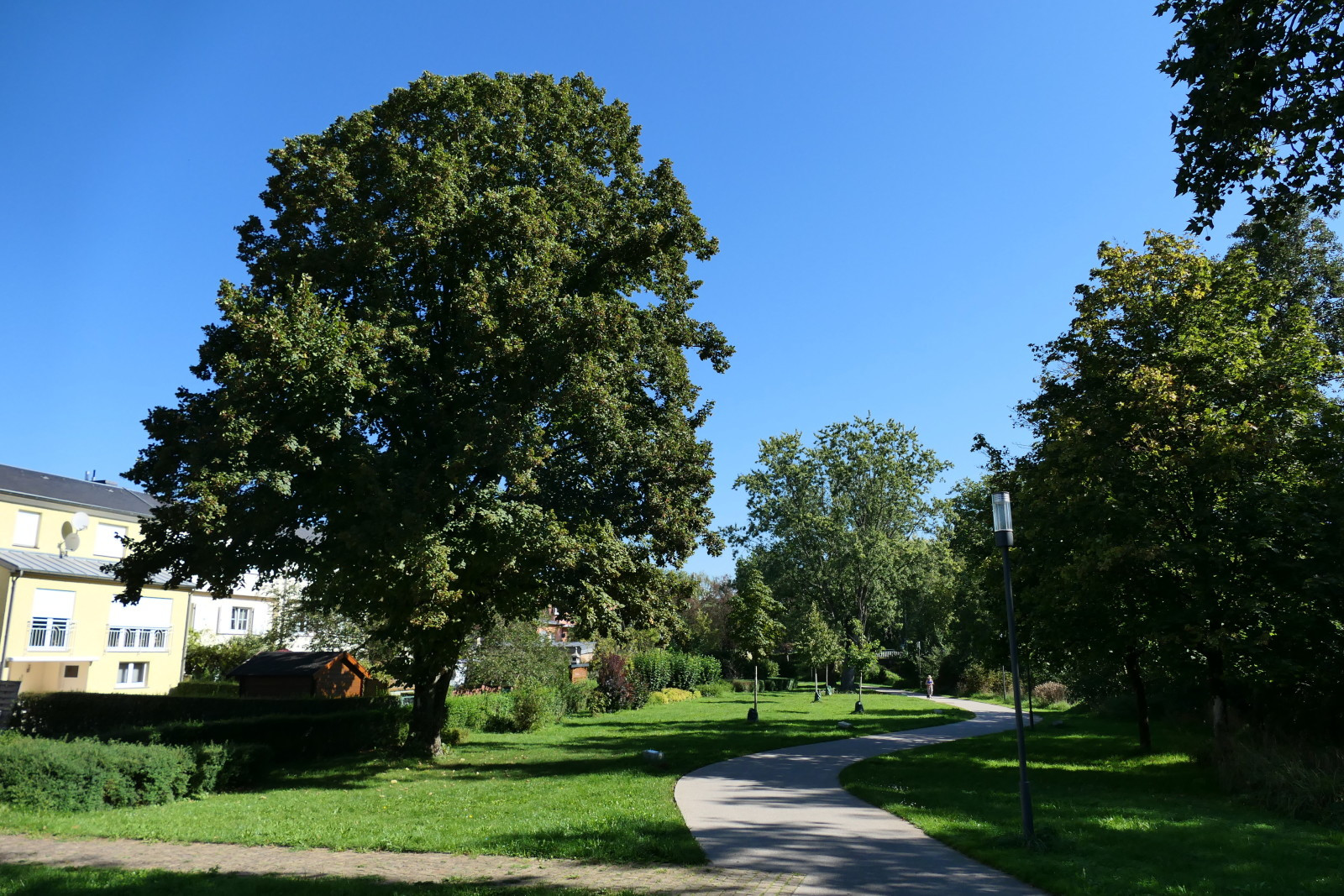
One of the many green spaces in the Cessange district © Luxembourg City Tourist Office
Towards a move to the outskirts?
As the government recently announced its tram expansion plan, new towns will be better connected to the capital and more easily accessible by public transport. Some companies and workers may therefore be tempted to relocate, and new centres of activity could emerge as a result.
This will notably be the case for Belval, already very popular, whose attractiveness could be further strengthened by a direct tram line. Other towns could also welcome many businesses following these changes, such as Foetz or Pontpierre. Companies will have more choice than ever when it comes to locating their offices, making Luxembourg even more attractive for workers.
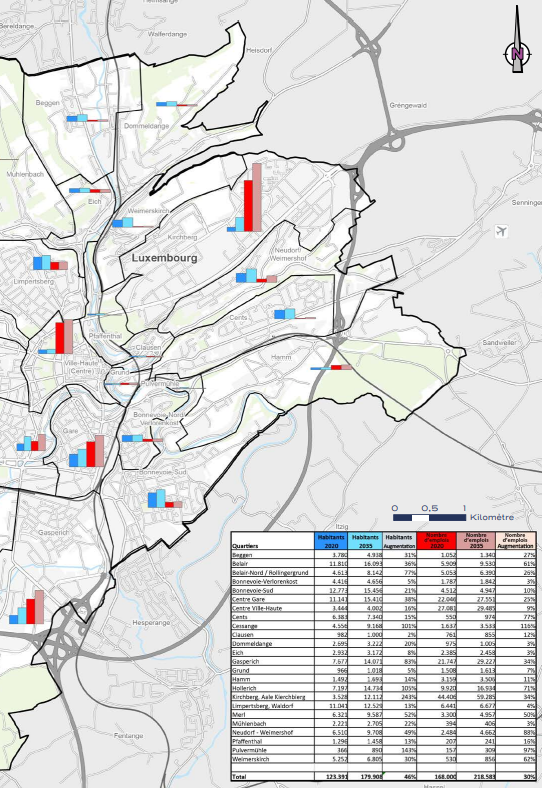
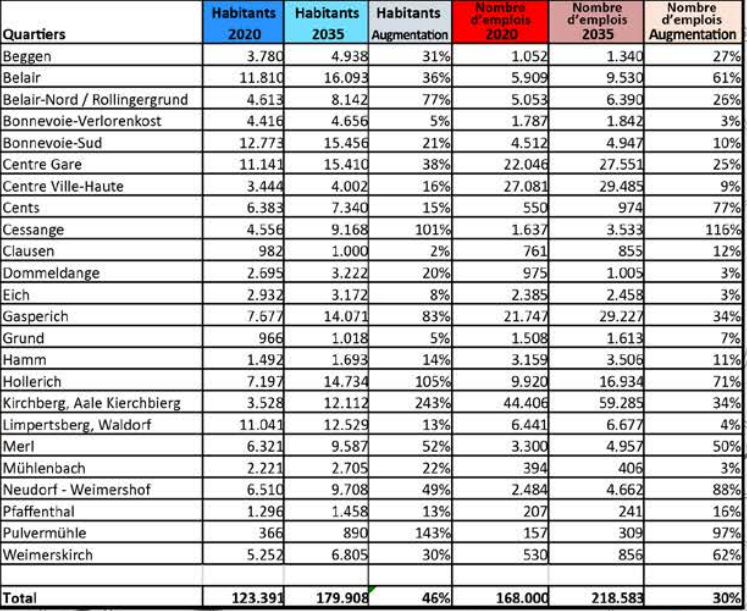
Population and employment development plan for the City of Luxembourg © City of Luxembourg
Interested in one of these districts? Filter the 4,000 job offers on Moovijob.com by location.