

Do you work in Luxembourg and have just received a dismissal letter? It can be a stressful time. Here's a simple and structured overview of your rights depending on the situation: dismissal during the trial period, with notice, for serious misconduct or collective redundancies.
Are you in your trial period?
The trial period allows both the employer and the employee to test the working relationship. During this phase, the contract can be terminated more easily and without compensation, provided certain rules are observed.
During the first two weeks, the contract cannot be terminated without the other party's agreement, except in the case of serious misconduct.
If the employee is unable to work, the employer cannot terminate the contract. The trial period is then extended by the duration of the absence, up to a maximum of one month.
In the event of pregnancy, no dismissal is allowed between the submission of the medical certificate and the end of the protection period. The trial period resumes afterwards for the remaining duration.
If the trial period exceeds two weeks, a notice period applies:
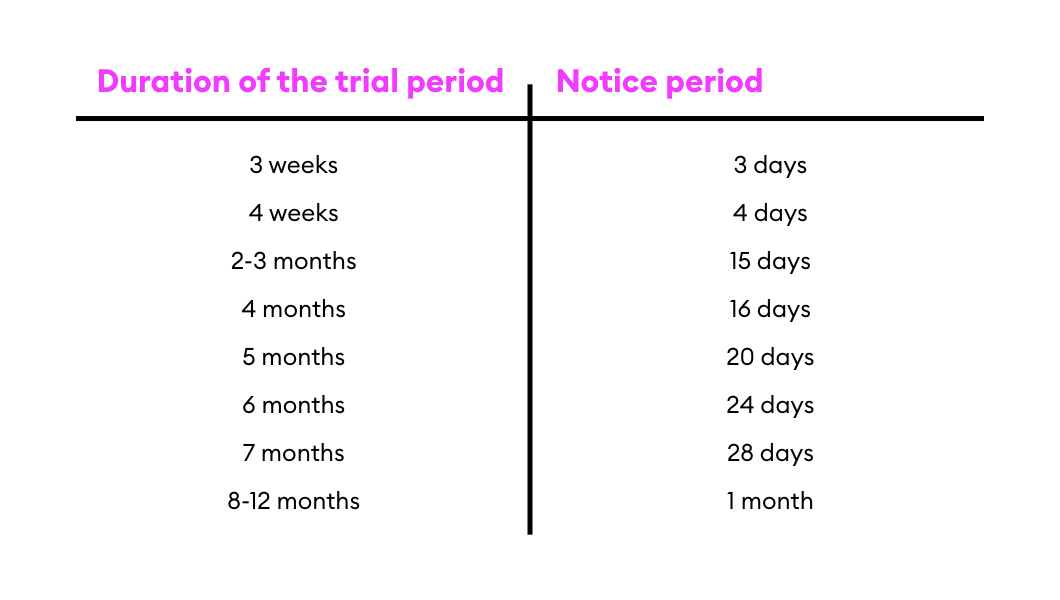
Termination must be made in writing, either by registered letter or handed over in person, against a signature. No justification is required, but the termination must not be abusive, discriminatory, or vexatious. In case of doubt, it is advisable to request a written explanation.
Is your contract terminated with notice?
Outside the trial period, the employer may terminate the contract with notice, without this necessarily being based on serious misconduct. This type of dismissal is the most common in Luxembourg.
The employee must be informed in writing, and the letter must mention the start of the notice period. If the employee submits a written request, the employer must justify its decision within one month.
Who does this apply to?
If the company has more than 150 employees, a prior interview is compulsory before the dismissal can be notified. In this case, the dismissal must then be notified:
- At the earliest: the day after the interview;
- At the latest: 8 days later.
A fixed-term contract (CDD) cannot be terminated with notice before its end date, except for serious misconduct. Otherwise, the employer will have to compensate the employee for the remaining period, up to the notice period provided for a permanent contract.
Dismissal is also prohibited during sick leave, maternity leave, or parental leave.
What are the valid reasons for dismissal?
Dismissal with notice must be based on a real and serious cause, linked to the employee's ability or conduct (repeated failure to comply with instructions, professional inadequacy, unjustified lateness or absences, inappropriate behaviour, etc.) or the needs of the company (internal reorganisation, economic difficulties, job cuts, etc.).
How long is the notice period?
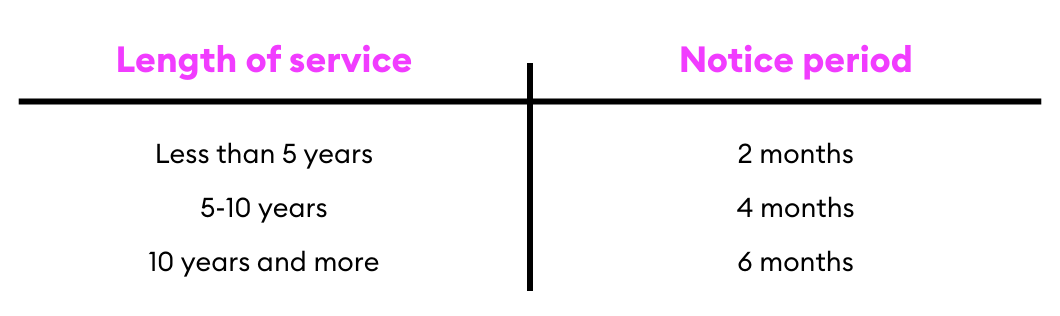
The notice period begins on the 15th of the month if the letter is delivered before the 15th, otherwise on the 1st of the following month.
What rights does the employee have during the notice period?
- 2 half-days per week paid for job-hunting;
- Payment of untaken leave;
- Severance pay after 5 years' service (amount increases with length of service);
- Right to a certificate of employment.
Are you dismissed for serious misconduct?
This is the most severe form of dismissal: the contract is terminated immediately, without notice or compensation. However, this is only allowed in the event of serious misconduct that makes it impossible to continue the working relationship.
An employee who is dismissed with notice and commits serious misconduct during the notice period may be dismissed for serious misconduct.
What counts as serious misconduct?
The misconduct must be serious and deliberate. Simple mistakes or negligence are not sufficient. There is no exhaustive list, but here are a few concrete examples:
- Theft or embezzlement;
- Falsifying documents;
- Physical or verbal abuse;
- Moral or sexual harassment;
- Unjustified job abandonment;
- Repeated refusal to obey legitimate instructions.
What rules must be followed?
The employer must act within one month of becoming aware of the facts. If an internal disciplinary procedure is in progress (hearing, investigation, etc.), this one month is temporarily suspended.
If the company has more than 150 employees, a prior interview is compulsory before any dismissal is notified. In this case, dismissal may only be notified:
- At the earliest: the day after the interview;
- At the latest: 8 days later.
The decision must be formalised in writing, preferably by registered letter with acknowledgement of receipt.
What happens next?
- No severance pay is due;
- No notice period is paid;
- Untaken leave must still be paid out;
- The employer may require the dismissed employee to reimburse the costs of training that it has incurred on his behalf (under certain conditions);
- The employee may contest the dismissal in court if the serious misconduct is unfounded.
Note: Employees may also terminate their contract immediately if they feel that their employer has committed a serious misconduct (non-payment of wages, endangering the employee, etc.).
Are you affected by a collective redundancy?
Collective redundancies occur when at least 7 employees are dismissed within 30 days, or at least 15 employees within 90 days, for reasons not related to the individual (restructuring, economic difficulties, etc.). The aim is often to reduce costs or restructure the business.
Who is affected?
These rules apply to private sector companies, regardless of their industry or size (though obligations vary).
What are the required steps?
The employer must inform the Employment Agency (ADEM) and the staff representatives (or the employees directly, if there are none) in writing or via a form. A social plan may be required if the redundancies involve a large number of people. ADEM may initiate a conciliation procedure to find alternative solutions (internal transfers, retraining, voluntary departures, etc.).
Notice and compensation
Each employee affected by a collective redundancy is entitled to:
- The usual notice period (depending on seniority);
- Severance pay if they have been with the company for 5 years or more;
- Payment of any remaining leave;
- Job-seeking hours during the notice period.
Note: In the event of a dispute, employees may take their case to the Labour Tribunal, either individually or collectively.
Each type of dismissal in Luxembourg involves specific rules. The most important thing is to keep all the documents you receive and don't hesitate to assert your rights. If necessary, contact the Inspection du Travail et des Mines (ITM), a trade union or a specialised lawyer.
See also:
Resignation in Luxembourg: what you need to know
Mutual termination of an employment contract in Luxembourg
Find out more about labour law in Luxembourg on our blog.