
.png)
It’s a question that often crosses the minds of job seekers: should you include a photo on your CV? Though seemingly trivial, this decision can significantly influence how an application is perceived. To better understand recruiters’ expectations and current practices, Moovijob.com conducted a survey across its social media platforms and carried out street interviews to gather opinions on the subject.
A common practice, but far from universal
The survey results reveal a genuine diversity of opinion: 42% of respondents believe a photo is essential when applying for a job, while 27% prefer to send a CV without one. The remaining 31% think the decision largely depends on the job offer and the industry concerned. This lack of consensus highlights how sensitive the topic remains and shows that, despite being a long-standing practice, nothing is truly set in stone.
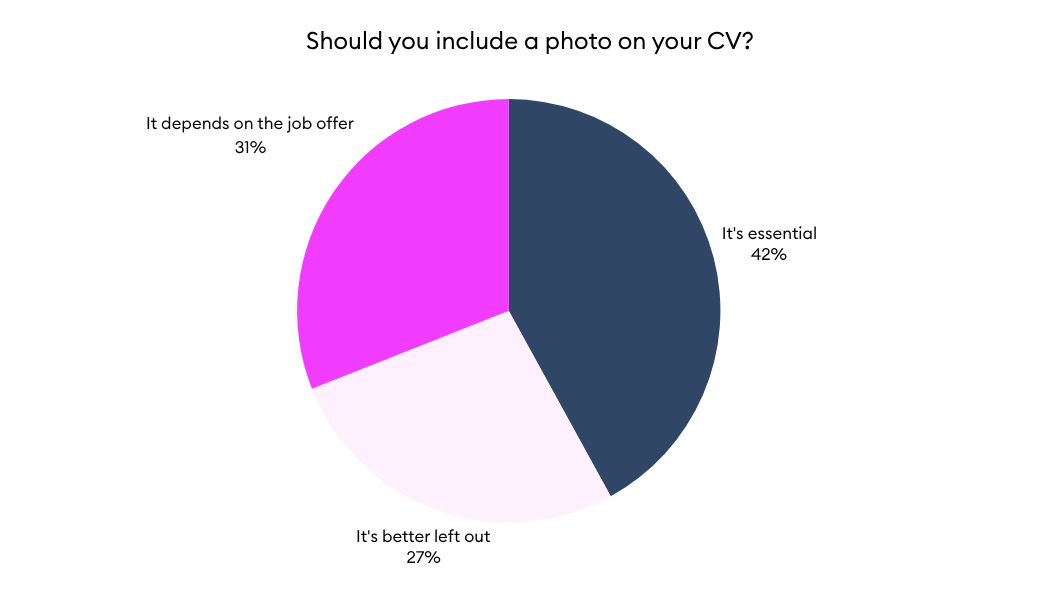
Graph showing opinions on photos in CVs
In Luxembourg, there is no law requiring a photo on a CV. However, in practice, many still choose to include one, often to align with what is seen as an implicit norm in certain sectors. Luxembourg remains attached to this tradition, especially in professions where presentation and human interaction play an important role.
In France, Germany, Luxembourg and Spain, including a photo is still a common practice, often viewed as a way to personalise an application. In Switzerland and Italy, the custom is also well established. By contrast, in Anglo-Saxon countries such as the United Kingdom, the United States or Canada, adding a photo is strongly discouraged, as recruiters seek to avoid any potential discrimination based on appearance.
Practices that vary by industry
Whether to include a photo often depends on the type of position being applied for. In fields such as hospitality, communication, customer service or sales, a photo is often seen as a valuable, if not essential, addition. It helps create a positive first impression and humanise the application.
"As a project manager, I like to know who I’ll be working with, so I’m in favour of including a photo",
said one respondent during our street interviews.
On the other hand, in more technical sectors such as IT, engineering or finance, photos are often considered unnecessary. What matters most in these industries are skills, qualifications and professional experience.
"In certain fields like aerospace, where I work, the photo really doesn’t matter. What counts above all are experience and skills", explained a Luxembourg employee.
A decision not to be taken lightly
Including a photo can offer some advantages. When done well, it can convey professionalism, help a candidate stand out, and create a lasting visual impression on the recruiter. It can also demonstrate awareness of local cultural norms, particularly in Luxembourg’s job market, provided it aligns with the sector and the company’s image.
However, this strategy is not without risk. A poor-quality, overly personal or simply unsuitable photo can quickly harm an application, distorting the recruiter’s perception of the candidate. Beyond aesthetics, the question also raises ethical and social issues. A supplementary Moovijob.com survey found that 51% of respondents cited the risk of discrimination as the main reason for not including a photo on their CV.
"I think it depends on the field you’re applying for, but also on other factors like skin colour, which can unfortunately be a barrier", explained one participant.
Others mentioned the wish to refocus the evaluation on skills and experience (16%), to protect their privacy (3%), or simply felt that a photo is irrelevant in a recruitment process (30%).
"I don’t like adding my photo to a CV because I don’t want my appearance to influence the hiring decision", said another respondent.
When image (still) shapes judgement
These numbers reflect a broader trend: more and more candidates are questioning the real usefulness of a photo, particularly when it can trigger unconscious bias.
Physical appearance, age, gender or origin should never influence a hiring decision. Yet personal choices such as piercings or tattoos can, in some cases, still affect how a candidate is perceived, despite a growing cultural shift towards inclusion and openness. And although Luxembourg law strictly prohibits discrimination, such practices have not completely disappeared and remain difficult to control or prove.
If, despite this, you decide to include a photo, here are our eight tips for the perfect CV photo.
Check out our street interview!
In the end, the choice is yours, depending on your sector, the quality of your photo, and your tolerance for potential bias. What truly matters, however, is a CV that is clear, structured, coherent and relevant.
Find more career advice in Luxembourg on our blog.