
In every employee’s life, certain personal events, joyful or difficult, require a break: wedding, moving, childbirth or death... In Luxembourg, labour law provides for special leave to help employees face these moments without losing their job or salary. This comprehensive guide explains all the types of special leave you may be entitled to.
When life knocks on the office door
Even if work occupies a large part of our lives, some events simply can't wait. Luxembourg law recognises these important moments and grants employees special leave to deal with them, without any loss of salary. This essential provision is governed by Article L.233-16 of the Labour Code.
What is special leave?
Special leave is an authorised, paid leave granted to an employee when an important personal event occurs, such as a wedding, a death, a move or the birth of a child.
This entitlement applies to all employees in the private sector, regardless of seniority, provided the absence is justified by an official document (such as a certificate, notice or summons).
The employment contract is, of course, suspended during this period, but the employee continues to receive full pay for the entire duration of the leave.
In practical terms:
- The employee is not subject to any qualifying period before exercising this right (unlike certain other types of leave).
- The salary is generally maintained by the employer throughout the leave period (although for certain specific types of leave, part of the cost may be covered by the State).
- The employment contract remains in force: the employer cannot dismiss an employee for requesting or taking such leave.
Different motives and durations
The main cases provided for under Luxembourg law (updated in 2025) include:
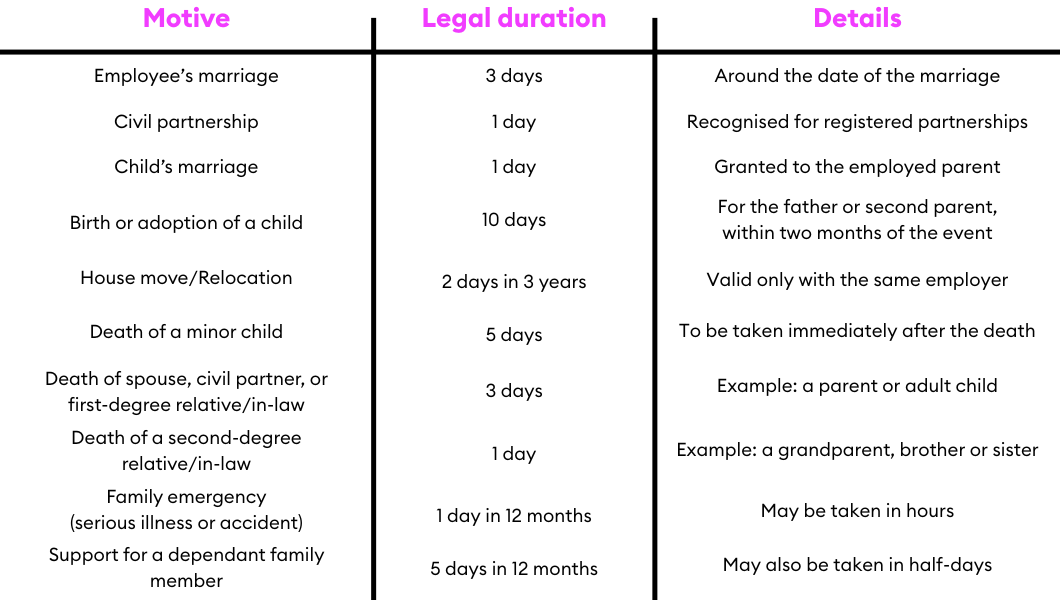
Table summarising the various types of special leave in Luxembourg
See also: Paternity leave in Luxembourg and the Greater Region.
The CNS also provides leave for family reasons to care for a child who is ill, has had an accident or is subject to isolation measures. Both parents are entitled to this leave, but cannot take it at the same time. The length of leave depends on the age of the child:
- 12 days, from birth to the age of 3;
- 18 days, from age 4 to age 12;
- 5 days, from age 13 to age 17, provided that the child is hospitalised.
There is also special leave for the exercise of civic rights and duties, for instance, to vote in municipal, legislative or European elections.
Additional clarifications:
- The leave must be taken at the time of the event or immediately after, unless otherwise agreed.
- Leave for moving house applies only to personal moves; a transfer required by the employer does not give entitlement to such leave.
- Certain types of leave (such as those related to dependency) are partially reimbursed by the State.
How to apply?
The procedure is straightforward:
- Inform the employer as soon as possible, ideally in writing.
- Provide supporting documentation: marriage certificate, birth certificate, death certificate, etc.
- The leave must be taken within a reasonable period around the event.
Special leave is paid as a normal working day. The employer can't refuse it without a valid reason and can't penalise an employee for making use of this right.
Key points to remember
- Certain collective agreements or company-level conventions may grant longer periods of leave; it is always worth checking.
- The staff register must record these absences as actual working time.
- These leaves can't be accumulated or carried forward. If they are not taken at the time of the event, they are forfeited.
- In the event of a dispute or unjustified refusal, the Inspection du travail et des mines (ITM), may be contacted.
The system of special leave shows that Luxembourg labour law is not limited to productivity, it also recognises the realities and joys of personal life. A wedding, a birth, a bereavement or a move: these milestones shape our lives, and the law ensures they can be experienced peacefully, even while in employment.
After all, life doesn’t just happen at the office.
Find more information about your rights as an employee in Luxembourg on our blog.