
.png)
Luxembourgish is a distinctive language, with sounds reminiscent of German, Dutch and, at times, French. It is spoken mainly in Luxembourg and certain neighbouring regions. Long regarded as a dialect, it is thought to have originated from Moselle Franconian, one of the dialects of West Central German, shaped over time by both Germanic and Romance influences.
A language that remained oral for a long time
Until the 19th century, Luxembourgish was primarily a spoken language. French and German dominated in writing, each in their own field.
Under the French occupation of Louis XIV in 1648 and again under the Revolutionary troops in 1795, French gradually established itself in the Grand Duchy. The Napoleonic Code of 1804 made French the country’s official administrative and legal language.
German, meanwhile, took root in the press and the economy, especially after Luxembourg joined the Zollverein, the German customs and trade union, in 1842, which attracted German capital and workers.
In daily life, however, Luxembourgish remained the language of the people.
The birth of a linguistic identity
From 1843, the Primary Education Act introduced multilingualism in schools: German and French were taught from primary level onwards, on an equal footing. This system gradually forged a unique linguistic identity, positioned between the French- and German-speaking worlds.
At the same time, Luxembourgish became a marker of national identity: dictionaries, poems and songs flourished, including the famous Ons Heemecht (“Our Homeland”, 1859), which would later become the national anthem.
20th century: assertion and recognition
During the German occupation (1940–1944), French was banned and Luxembourgish was downgraded to the status of a dialect to justify annexation to the Reich. In the 1941 census, however, the population rejected German and overwhelmingly declared Luxembourgish as their mother tongue, reinforcing its identity role.
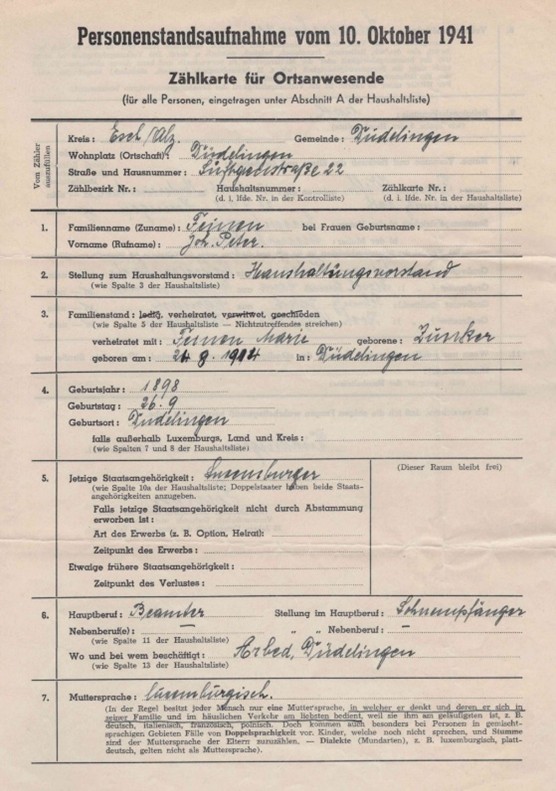
Excerpt from a census form © Kanerz Art
After the Second World War, the Luxembourgish language regained its rightful place and underwent modernisation.
In 1948, the Constitution reaffirmed the use of French and German but left it to lawmakers to regulate their application. The 1984 Language Law officially recognised Luxembourgish as the national language and placed it alongside French and German in administration and justice. Finally, Europe granted it symbolic recognition through the “Lingua” programme in 1989.
In the 21st century, social media and digital platforms have marked a major turning point: for the first time, Luxembourgish has become a written language of everyday life.
One example is the seven high schoolers from the Athénée who launched “LëtzLearn”, a fun app offering online language courses to make learning Luxembourgish easier and more engaging.
A living language and a professional asset
Today, around 61% of the country’s inhabitants use Luxembourgish in their daily lives: at home, at school or at work. The language has experienced a significant revival since the 2008 Nationality Law, which requires passing a Luxembourgish test. Demand for Luxembourgish courses at the INL has more than tripled between 2008 and 2022.
But learning Luxembourgish also means:
- Integrating more easily into social and cultural life;
- Communicating more smoothly with colleagues and neighbours;
- Discovering the country’s rich history and identity.
Creation of the Luxembourgish language day
On 26 September 2025, the very first edition of the Dag vun der Lëtzebuerger Sprooch (Luxembourgish Language Day) will take place. This date aligns with the European Day of Languages and will highlight the Luxembourgish language across various fields. The program will feature conferences, concerts, exhibitions, and educational activities to celebrate both Luxembourgish and multilingualism.
Your turn
Before you dive in, Moovijob.com is giving you a few basics so you can approach your first lesson with confidence!
Hello = Moien
Goodbye = Äddi
How are you? = Wéi geet et?
I’m fine / not well = Mir geet et gutt / schlecht
Thank you = Merci
Do you speak Luxembourgish? = Schwätzt Dir Lëtzebuergesch?
Yes = Jo
No = Nee
You’re welcome! = Gär geschitt!
A language of history, identity, and now of the future, Luxembourgish is more than ever an asset for anyone living or working in Luxembourg.
Find all our training offers to learn Luxembourgish on Moovijob.com!