
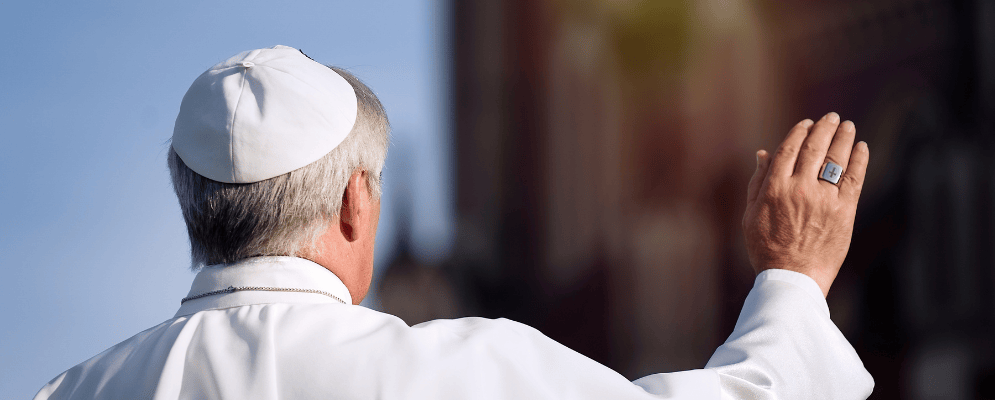
Pope Francis, elected on 13 March 2013, passed away on Monday, 21 April at the age of 88, following a stroke. As the Church enters a period of mourning, attention is already turning to the future: who will succeed him? Among the names being mentioned is that of Luxembourgish Cardinal Jean-Claude Hollerich. Moovijob.com sheds light on the late Pope’s historic visit to Luxembourg, the election of the next pontiff, and what it means to be a cardinal.
The Pope visited the people of Luxembourg
On Thursday, 26 September 2024, just ahead of the 11th edition of the Unicareers fair, Pope Francis paid a visit to the Grand Duchy of Luxembourg, a historic first for the nation. After travelling through the city’s streets in the popemobile, greeting the large crowd that had gathered despite the morning rain, the Holy Father made his way to the Notre-Dame Cathedral of Luxembourg to celebrate Mass in the presence of numerous political, religious and civic figures.
In his address, the Pope stressed solidarity among people, the duty to welcome the most vulnerable, and the importance of interfaith dialogue, themes central to his pontificate*.
This visit was part of a broader initiative to draw closer to the church’s peripheries and to nations often overlooked in Vatican diplomacy. It reflected his wider vision of a church that reaches out to the margins, to the poor and the forgotten.
Luxembourg’s cardinal: the next Pope?
Since Pope Francis’s passing, the question of his successor has animated the Catholic world. Among the names in circulation, one figure stands out: luxembourgish Cardinal, Jean-Claude Hollerich.
He is prominently featured on a list of fifteen frontrunners published by AFP. His unique journey, including a lengthy mission in Japan, his fluency in at least five languages, and his openness to intercultural dialogue all make him a serious contender.
Made cardinal in 2019, Hollerich has spoken in favour of a more inclusive church, and has not shied away from addressing sensitive issues such as homosexuality, priestly celibacy, and welcoming migrants. Positions that have drawn both admiration and criticism.
Despite this international attention, Cardinal Hollerich remains very humble about the possibility.
“There are others far more qualified than me”, he told L’Essentiel a year ago.
More recently, in an interview with RTL, he reiterated that he does not see himself becoming Pope, firmly rejecting the idea with a categorical “no”.
How is the pope chosen?
For centuries, only cardinals have been eligible for the papacy, as they are already entrusted with key responsibilities and understand the workings of the church.
The election of a new pontiff takes place during a conclave, which begins between the 15th and 20th day after the Pope’s death. On that date, all cardinals under the age of 80 meet behind closed doors in the magnificent Sistine Chapel, entirely cut off from external influence.
The process involves secret ballots. A candidate must receive a two-thirds majority to be elected. If no decision is reached in the first round, up to four ballots may be held each day, with periods of prayer and reflection in between. If voting remains deadlocked, the number of options is narrowed, and cardinals may then vote only between the two leading candidates from the previous round, or elect one by absolute majority.
And how does the world know when a decision has been made? Everyone watches the chimney of the Sistine Chapel: black smoke means no pope has been chosen yet; white smoke, accompanied by the ringing of Saint Peter’s Basilica bells, signals the election of the new head of the Catholic Church.
How does one become cardinal?
There’s no training course for becoming a cardinal, the title is granted directly by the Pope. He selects bishops who have distinguished themselves through service to the church, theological expertise, or diplomatic skill, according to priorities he has set for the church during his pontificate.
According to estimates reported in the local press, a cardinal in Luxembourg may earn between €4,000 and €6,000 net per month, depending on expenses, benefits, and additional duties.
The conclave is expected to begin between 5 and 10 May. During this time, the 135 cardinal-electors, around 80% of whom were appointed by Pope Francis himself, will gather to choose his successor. Will the cardinal from the Grand Duchy be the chosen one?
Visit our blog to learn more about Luxembourg!
Pontificate*: period during which a pope serves as the head of the Catholic Church.