
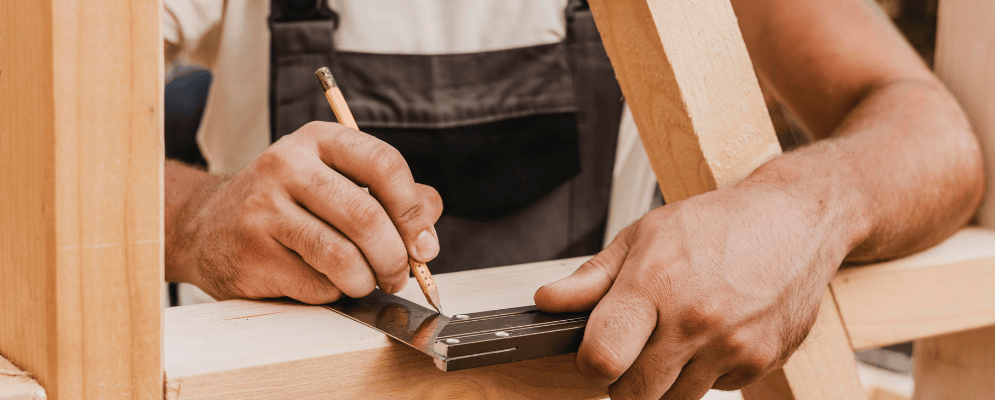
In this series of articles, discover various professions you can find in Luxembourg.
The carpenter profession
The role of a carpenter (also called a joiner) involves creating, transforming and assembling wood to bring useful and attractive pieces to life. It is a job where precision meets creativity. Carpenters shape spaces, repair, manufacture bespoke items and support their customers in bringing their projects to life.
A true everyday craftsman, they master both traditional tools and modern machinery. They measure, cut, adjust and assemble with care. But their role goes beyond technical skills: they advise, listen to needs, propose appropriate solutions and ensure that each project is durable, functional and harmonious.
Whether manufacturing furniture, installing interior or exterior joinery, renovating homes or creating bespoke fittings, carpenters draw on a range of technical, manual and interpersonal skills. Their expertise and know-how contribute to the success of each project and the satisfaction of those who entrust them with their spaces.
The duties of a carpenter:
- Read and interpret plans and measurements;
- Cut, shape and assemble wood or wood-based materials;
- Manufacture doors, windows, furniture or bespoke fittings;
- Install interior and exterior joinery;
- Carry out finishing work (sanding, varnishing, treatments...);
- Repair or replace existing joinery elements;
- Use and maintain workshop tools and machinery;
- Advise clients on materials and technical solutions.
Education and skills
Several education programs allow access to the carpenter profession:
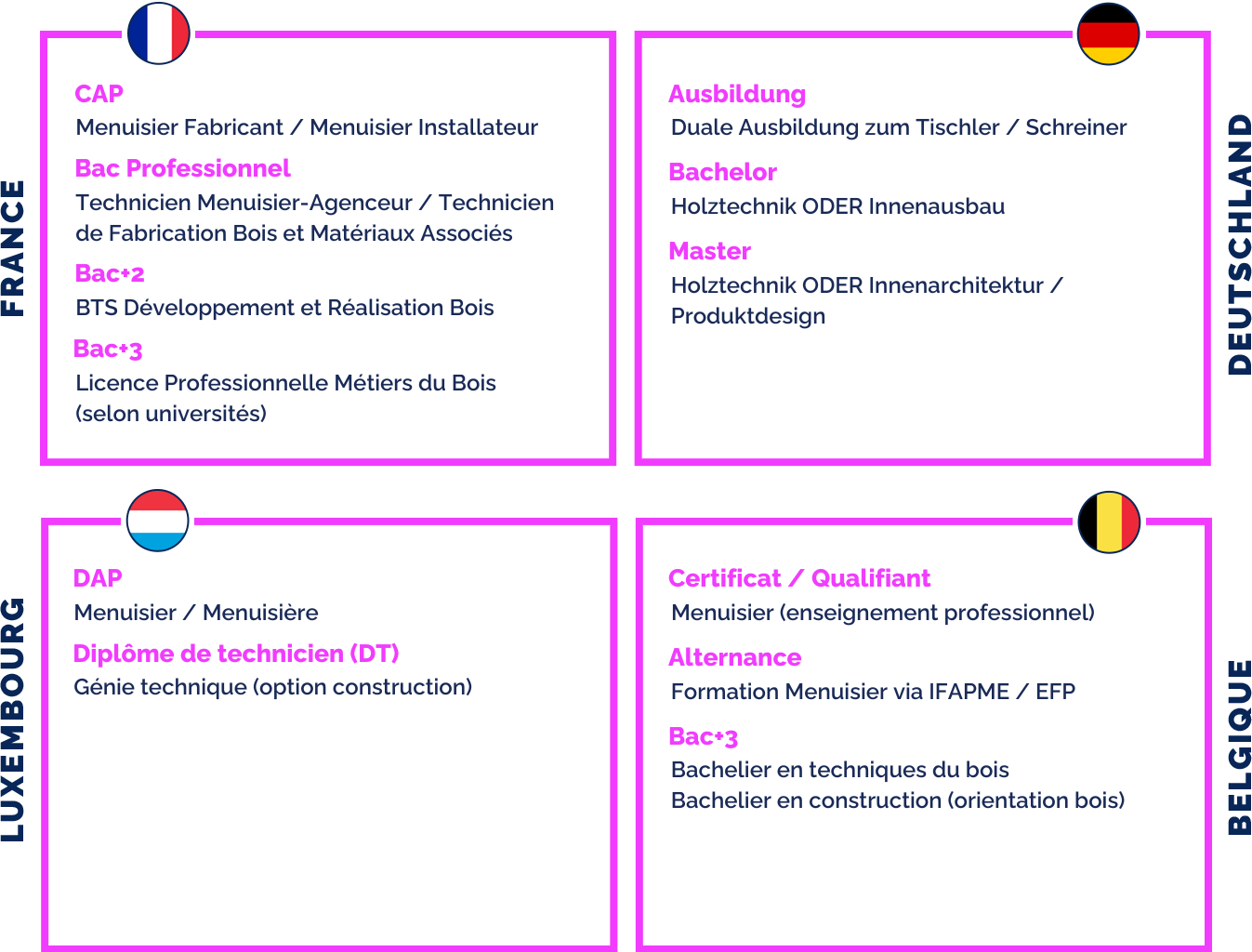
Table showing French, German, Luxembourg and Belgian qualification levels for the carpenter profession in Luxembourg
These academic programmes provide a solid foundation in carpentry while allowing students to choose the type of qualification they wish to obtain and specialise in their preferred field.
In addition, numerous in-house training courses, workshop apprenticeships and company mentoring schemes enable professionals to gradually develop the know-how and qualities required to grow in the profession and gain autonomy.
These training courses help develop the essential skills for this profession:
- Precision and rigour: measuring, cutting and assembling materials exactly;
- Organisation: planning manufacturing or installation stages to meet deadlines and quality standards;
- Communication: clearly exchanging information with clients, colleagues or suppliers;
- Problem-solving: managing unexpected situations on site or in the workshop, adjusting parts or methods if necessary;
- Creative and technical mindset: designing aesthetic and functional solutions tailored to projects;
- Adaptability: adjusting to different materials, site constraints or technical developments;
- Mastery of tools and machinery: safe and efficient use of hand tools, machines and design software.
The different types of carpenters
Manufacturing Carpenter:
- Works in a workshop designing and manufacturing various wooden elements (stairs, furniture, windows...);
- May produce bespoke or mass-produced items.
Installation Carpenter:
- Works on-site to install joinery elements;
- Makes adjustments on site if necessary, such as installing kitchens, bathrooms, parquet flooring and windows.
Industrial Carpenter:
- Produces items in small or large series;
- Uses conventional, CNC or automated machines based on pre-established plans.
Specialisations and fields
Interior carpentry:
- Interior fittings such as cupboards, stairs, doors and flooring;
- Often involves bespoke creations to optimise space.
Exterior carpentry:
- Windows, French windows, shutters, gates and fences.
Metal joinery:
- Uses materials such as steel and aluminium (garage doors, conservatories, pergolas...).
PVC joinery:
- Specialises in PVC for windows, roller shutters...
Mixed Joinery:
- Combines different materials to leverage their advantages (e.g. wood and aluminium).
Career prospects
Carpenters can progress to positions such as:
- Workshop manager or site supervisor;
- Specialist in cabinet-making or high-end interior fittings;
- Entrepreneur or independent craftsman;
- Trainer or apprentice supervisor.
Being a carpenter in Luxembourg
Carpenters are in demand across many sectors in Luxembourg: construction, renovation, interior design, bespoke furniture, craft and industrial companies...
In Luxembourg, speaking several languages is often an asset for a carpenter, especially when working directly with clients or on international projects. The country has three official languages (Luxembourgish, French and German) and many companies also operate in English. A carpenter who can communicate easily in several languages can better understand customers' needs and coordinate effectively with various partners.
A carpenter's salary in Luxembourg depends on their experience, specialisation and company:
- At the start of their career, a carpenter can expect a gross monthly salary between €2,500 and €3,200.
- With experience, salaries may reach €4,500 to €5,500, or even more for specialised or self-employed carpenters.
Some carpenters may also benefit from performance-related bonuses, travel expense reimbursements or additional company-specific advantages.
Did you know?
The Grand Duchy, experiencing strong urban growth and building renovations, requires many carpenters for both public and private projects. Carpenters specialising in interior fittings, bespoke furniture or exterior carpentry are particularly sought after. Modern projects increasingly require advanced technical and creative skills.
Find all carpenter and joiner job offers in Luxembourg on Moovijob.com.
If you want to learn more about professions in Luxembourg, visit our blog.