
.png)
Do degrees still hold the same value they did 10, 20, or even 30 years ago? To answer this pressing question, Moovijob.com conducted a survey and gathered testimonials.
A shared observation: a declining perception
A recent survey conducted by Luxembourg’s leading job board, Moovijob.com, examined how people perceive the evolution of degree quality over time. According to the results, 10% of respondents believe the quality has remained stable, 26% think it has improved, while 64% feel it has declined.
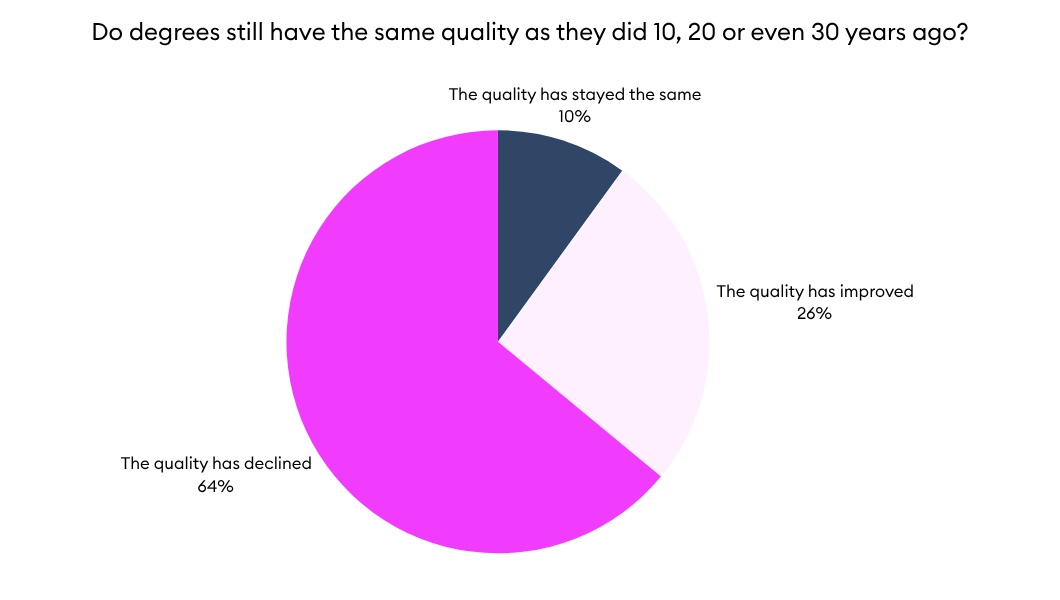
Evolution of degree quality over time
In other words, nearly two-thirds of respondents believe that degrees have lost their value. A harsh verdict that raises numerous questions about teaching methods, the democratisation of higher education, and how well qualifications align with the actual needs of the labour market. Let's take a closer look.
A changing educational landscape
Digital tools, project-based learning, collaborative teaching… Modern approaches are more interactive and student-centred. Yet these changes are sometimes perceived as a loss of academic rigour. While traditional methods emphasised effort and memorisation, newer pedagogies promote autonomy, though some fear this comes at the expense of learning depth.
"In recent decades, we’ve seen a flood of new degrees competing with traditional institutions... While some do offer real added value, many vary greatly in quality from one school to another," observes Pierre Schneider, HR Specialist.
Expanding access to higher education is undoubtedly a step forward, enabling more young people from diverse backgrounds to pursue a degree. However, this democratisation is sometimes associated with a drop in standards: "Ultimately, the number of academic titles and graduates has increased, but the average level has dropped," Pierre Schneider points out.
Another area of concern is the alignment between training programmes and companies’ real-world expectations. Several respondents mentioned a gap between theoretical knowledge and practical workplace skills. Programmes do not always keep pace with rapid innovation or sector-specific changes, leaving many graduates unprepared for the realities of the job market.
"Most of the time, we forget what we learned at school and discover a new way of thinking, working, and understanding… Real knowledge comes with experience, because school is mostly theoretical," explains Erhan Bolat, IT Legal Technology Specialist at DLA Piper Luxembourg.
"Diplômite" or educational progress?
In the face of these criticisms, the debate remains open: is this simply an inflation of diplomas or a genuine advance for society? The answer is less clear-cut than it might seem.
Today, many roles require a bachelor’s, master’s, or even higher-level qualification. This academic obsession can become a barrier for those pursuing more technical or vocational paths. Some even refer to this trend as “diplômite” (a French term), describing an obsession with formal qualifications that can overshadow tangible skills. In response, some companies are now turning towards atypical profiles, self-taught individuals or those undergoing career changes.
On the other hand, the expansion of study options and the opening up of higher education are seen as real societal progress. Modern curricula no longer only train for a particular profession, but also develop cross-disciplinary skills, as an Engagement Assistant at KPMG Luxembourg points out:
“Universities have not only modernised their teaching methods but also raised academic standards in many areas. There’s now a stronger focus on critical thinking, interdisciplinary learning and course content that reflects today’s global challenges.”
Many institutions now include practical modules such as internships, work placements, group projects, and international experiences. The aim is to better prepare students for the real-world challenges they’ll face in the workplace. This points to a growing blend of theory and practice: “I believe today’s degrees prepare students better for the professional world than in the past. Many universities are deeply involved in research and innovation, which helps students become more aware of real-world issues,” the Engagement Assistant adds.
Towards a broader definition of talent
Companies in Luxembourg are also adapting their recruitment criteria. While diplomas are still the benchmark, they are no longer the sole determining factor in recruitment.
Employers now seek individuals who can take action, adapt quickly and solve practical problems. As Erhan Bolat from DLA Piper Luxembourg explains: “I look for someone with the right mindset, a person who’s willing to learn and open to new ways of thinking, someone who can think outside the box.” Hands-on experience, such as internships, placements, volunteering, or personal projects, is gaining importance when evaluating a CV.
A previous study by Moovijob.com even revealed that 40% of recruiters no longer rely solely on degrees, believing that experience comes first.
Soft skills such as the ability to learn, manage stress, display emotional intelligence, and communicate effectively are increasingly valued, especially in a multicultural and fast-changing environment like Luxembourg.
With the increasing pace of technological change, recruiters are looking for profiles that are committed to lifelong learning. Certifications, online courses, and upskilling initiatives are now seen as clear signs of agility and motivation.
Even though more and more schools now offer internships and sandwich courses to help students transition into the workforce, degrees often remain overly theoretical. And in a world where more and more people hold degrees, the diploma itself is starting to lose its value in the eyes of recruiters. Today, it’s concrete skills and real-world experience that make the difference, even though many companies still use qualifications as a basis for determining salary levels.
Explore training courses, job opportunities, and internships in Luxembourg on Moovijob.com.