
.png)
We’re already more than three months into 2026. Time really flies! It’s the perfect moment to take a first look back.
Here’s a summary of the key employment news from this first quarter, in case you missed anything.
Labour market
The unemployment rate reached 6.3% in January 2026, the highest level recorded at the start of a year since 2021.
ADEM recorded 21,255 job seekers, an increase of 9.4% compared to January 2025. The most qualified job seekers were the most affected (+15.9% year-on-year). By age group, those aged 30-44 were the most impacted (+11.3%), followed by under-30s (+8.9%) and those over 45 (+7.8%).
In February, the unemployment rate remained at 6.3%.
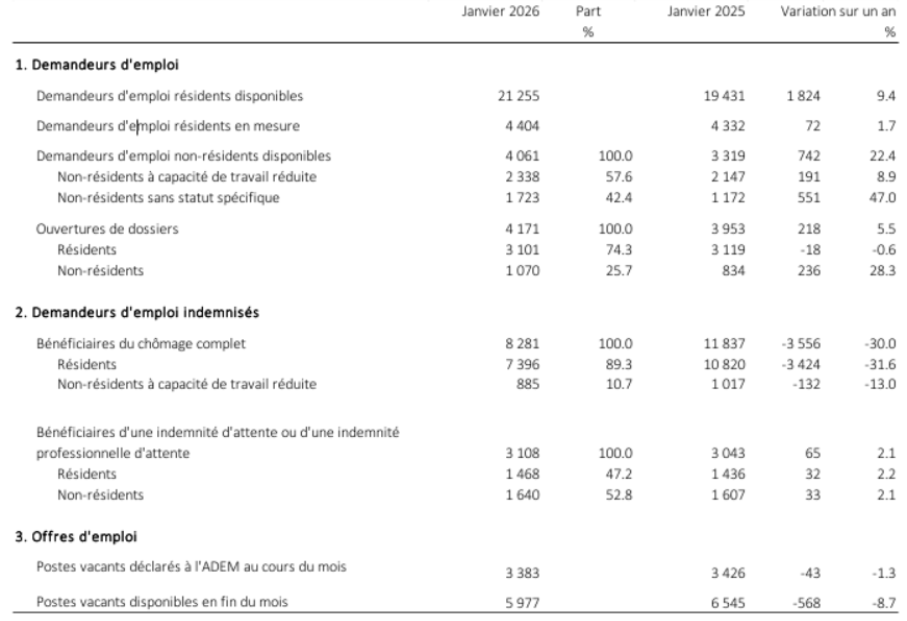
Unemployment rate in January 2026 © STATEC
To attract talent from all over the world, the government has launched the online platform Work in Luxembourg, as well as the Talent Desk in Kirchberg. These tools are designed to make it easier for international workers to move to the Grand Duchy.
You can also explore the list of shortage occupations in Luxembourg in 2026, according to ADEM.
Inflation and indexation
In January 2026, inflation slowed significantly in Luxembourg, dropping from 3.1% in December 2025 to 1.3%. This decline was less pronounced across the eurozone as a whole, falling from 2.0% to 1.7%. This can be explained in part by the government’s contribution to electricity network usage charges. The rate remained at 1.3% in February before rising again to 2.4% in March, largely due to international conflicts that drove up energy prices.
Despite the slowdown at the beginning of the year, STATEC estimates that the next wage indexation should take place in the second quarter. Two scenarios are being considered, one with high inflation and one with lower inflation, although the latter is considered less likely. If inflation remains relatively low, the indexation could be postponed to the third quarter. Rising fuel prices are also expected to have a significant impact on the triggering of an indexation, should they remain relatively high in the coming weeks.
Increase in the minimum wage
The Luxembourg government recently announced an increase in the minimum wage for 2027. On 1 January 2027, the social minimum wage (SSM) will rise by 3.8%. This represents an increase of €170, provided that indexation takes place as planned later this year. The SSM will then rise from around €2,703 to €2,875. A third of this increase (1.3%) will be covered by the state, meaning that employers will only have to contribute 2.5%.
The development of AI in Luxembourg
According to a study conducted by LISER (Luxembourg Institute of Socio-Economic Research), Luxembourg is the country in the Greater Region where businesses make the most use of artificial intelligence. The survey, conducted in 2024, reveals that 23% of Luxembourg companies report using AI in some form. This is significantly higher than in neighbouring countries (16% in Germany, 10% in France and only 8% in Belgium). This lead is largely due to the strong presence of financial firms in the Grand Duchy, which make extensive use of AI. The study also highlights that the figure could fall to 14.3% if the financial sector is excluded from the calculations.
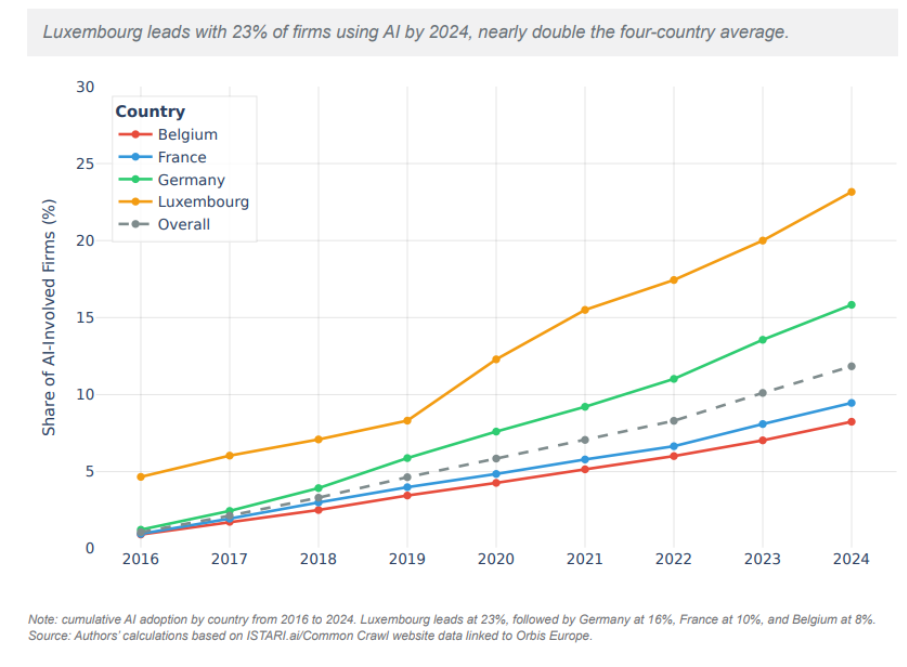
Trend in the proportion of companies using AI between 2016 and 2024 in the Greater Region © LISER
At the same time, the government launched the AI4LUX campaign, which aims to make it easier to use AI as a tool serving Luxembourgish citizens. It is the result of a partnership with Mistral AI, a French company that is one of the leading players in AI in Europe.
For more news on the labour market in Luxembourg, visit our blog.