

In this series of articles, discover various professions you can find in Luxembourg.
The role of a doctor
A doctor prevents, diagnoses and treats illnesses, while supporting patients in managing and monitoring their health. It is a profession where scientific rigour meets empathy and human interaction.
As a key pillar of the healthcare system, doctors have a strong command of both fundamental medical knowledge and modern diagnostic tools. However, their role goes beyond technical expertise. They inform, reassure, prevent illness and ensure that every aspect of patient care is safe, appropriate and respectful.
Whether working in a medical practice, clinic or hospital, in general practice or in a specialist field, doctors draw on a combination of scientific, technical and interpersonal skills. Their expertise and commitment directly contribute to the health and well-being of the people entrusted to their care.
A doctor's main responsibilities:
- Examining patients, taking their medical history and assessing their symptoms;
- Making a diagnosis and determining the appropriate course of treatment;
- Prescribing additional tests, treatments or medication;
- Providing medical follow-up and preventive care (vaccination, screening, healthy lifestyle advice);
- Referring patients to specialists or hospital departments when necessary;
- Keeping medical records up to date while respecting professional confidentiality;
- Undertaking continuous professional development to keep up with advances in medical knowledge;
- Advising patients and their relatives on their health and treatment.
Education and skills
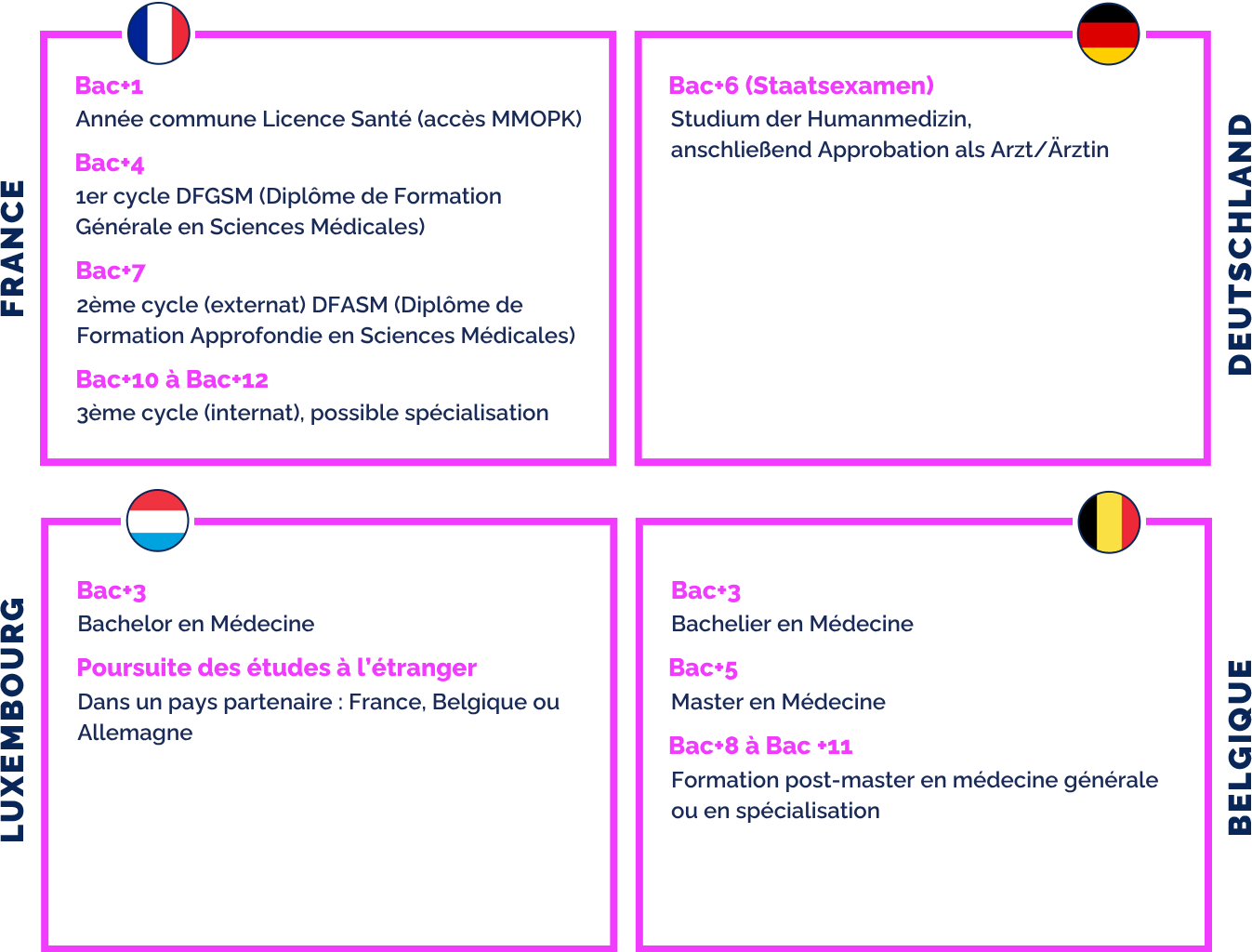
Table showing the French, German, Luxembourgish and Belgian qualification levels for the profession of doctor in Luxembourg
These academic pathways provide a solid foundation in medicine while allowing students to choose the type of qualification they wish to obtain and specialise in their chosen medical field.
Authorisation to practise medicine in Luxembourg is issued by the Ministry of Health, upon presentation of a recognised qualification and subject to sufficient language proficiency (French and/or German, often B2 or above).
In addition, numerous clinical placements, mandatory continuous training and supervision by senior doctors help professionals gradually develop the practical skills and qualities required to progress in the profession and gain greater autonomy.
This training enables doctors to acquire the essential skills required to practise the profession:
- Scientific rigour: making reliable diagnoses and prescribing appropriate treatment;
- Observation skills: identifying clinical signs and detecting abnormalities;
- Communication: communicating clearly with patients, their relatives and other healthcare professionals to understand their needs and explain medical decisions;
- Problem-solving: managing complex or urgent situations and adapting patient care when necessary;
- Empathy and active listening: supporting patients with compassion, particularly during difficult times;
- Adaptability: adjusting to different patient profiles, working conditions and developments in medicine;
- Proficiency with medical tools: using diagnostic equipment, medical software and care protocols safely and effectively.
The main types of doctors
General practitioner (GP):
- Provides comprehensive medical care to patients, regardless of their age or condition.
- Is often the first point of contact with the healthcare system and refers patients to specialists when required.
Medical specialist:
- Focuses on a specific area of medicine (cardiology, paediatrics, dermatology, gynaecology, etc.).
- Generally works following a referral from a GP or in a hospital setting.
Hospital doctor:
- Works within a hospital or clinic, often as part of a multidisciplinary team.
- May be required to respond to emergencies or manage complex cases.
Specialisations and fields
General practice:
- Comprehensive and continuous patient care, prevention and long-term monitoring.
Internal medicine and medical specialities:
- Cardiology, respiratory medicine, gastroenterology, neurology, medical oncology...
Surgery:
- General, orthopaedic, paediatric or specialist surgery performed in an operating theatre.
Paediatrics:
- Specialised medical care for infants, children and adolescents.
Psychiatry:
- Management of mental health and psychiatric disorders.
Emergency medicine:
- Rapid management of acute medical situations, either in emergency departments or in pre-hospital settings.
Being a doctor in Luxembourg
Doctors are in demand in many sectors in Luxembourg: hospitals, clinics, private practices, occupational medicine, public health administrations...
In Luxembourg, speaking several languages is essential for practising medicine, particularly when working with patients. The country has three official languages (Luxembourgish, French and German), while many patients and colleagues also communicate in English or Portuguese. Authorisation to practise, issued by the Ministry of Health, generally requires proficiency in at least two languages, most commonly French and German. A doctor who can communicate confidently in several languages is better able to understand patients' needs and coordinate their work with different healthcare professionals.
A doctor's salary depends on their experience, specialisation and working arrangement:
- At the start of their career, a GP can expect a gross monthly salary of between €4,400 and €5,500.
- With experience, salaries can reach €6,000 to €9,000 per month, or even more for medical specialists or those working in private practice.
It should be noted that some doctors may receive paid on-call allowances, bonuses for out-of-hours duties or other benefits, depending on the organisation they work for. The income of self-employed doctors can also vary considerably depending on their patient base and specialisation.
Career prospects
Doctors can progress towards positions such as:
- Head of department or hospital department manager;
- Medical specialist following additional training;
- Self-employed doctor in private practice;
- Teacher or supervisor for junior doctors and medical students.
Did you know?
The Grand Duchy is facing an anticipated shortage of doctors and is investing in the development of its own medical training programme. Since 2020, the University of Luxembourg has offered a Bachelor's degree in Medicine, providing a first step towards a more comprehensive medical training pathway in the country. Specialisations in general practice, neurology and medical oncology are already available locally, while a Master's degree in Medicine is currently under consideration.
Find all doctor job vacancies in Luxembourg on Moovijob.com.
If you would like to learn more about professions in Luxembourg, visit our blog.