.png)
We all have this image in mind of a leader: confident, visionary, charismatic, making decisions in three seconds flat and never doubting themselves.
But does one naturally become a leader, or can anyone develop into one? Does the saying "Where there's a will, there's a way" really hold true? Or is leadership something extra that only certain people possess?
Well, the answer is yes, there are common traits among leaders, but not necessarily the ones you might expect...
Personality traits commonly found in leaders
You do not need an IQ of 200, but you do need to be able to say, "Right, this is what we're going to do." A good leader is not the one who shouts the loudest, but the one who helps others move forward.
Here are some of the traits most often found in successful leaders:
- A clear vision: they know where they are heading and, more importantly, can explain it to others.
- The ability to influence and motivate: they do not simply manage, they drive progress.
- Listening and communication skills: they are not in the "I decide everything" camp.
- Stress resistance and resilience: they can take setbacks without falling apart.
Studies on personality and leadership show that certain traits from the Big Five model are frequently associated with effective leadership:
- Extraversion: a personality trait characterised by an orientation towards the outside world;
- Conscientiousness: a tendency to demonstrate self-discipline, organisation, responsibility and perseverance;
- Openness: a personality trait that reflects intellectual curiosity, creativity, imagination and a desire for novelty.
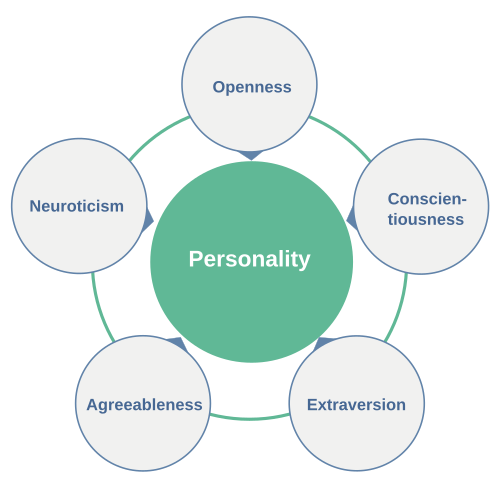
The Big Five Model
In short, you do not need to be a genius. But you do need to keep moving forward, even when the path is unclear.
Background: prestigious education or the school of life?
People often assume that leaders come from the most prestigious institutions. Sometimes that is true, but it is far from a rule.
Many leaders of Fortune 500* companies attended elite universities. However, this is neither a guarantee of success nor a mandatory step. For example, Steve Jobs, former Chief Executive Officer of Apple, never completed his studies, while Mark Zuckerberg, CEO of Meta, left Harvard before graduating.
In most cases, it is experience in the field that shapes a leader. A degree may open doors, but without practical experience, it is difficult to become a true leader.
The qualities most frequently found among leaders include:
- Significant experiences (hands-on work, major projects, start-ups, crises);
- A willingness to take risks;
- The ability to learn and adapt quickly;
- A results-oriented mindset.
What management research (particularly from Harvard Business Review and McKinsey) consistently shows is that qualifications alone do not make the difference, it is what you do with them that matters.
Physical characteristics and perception
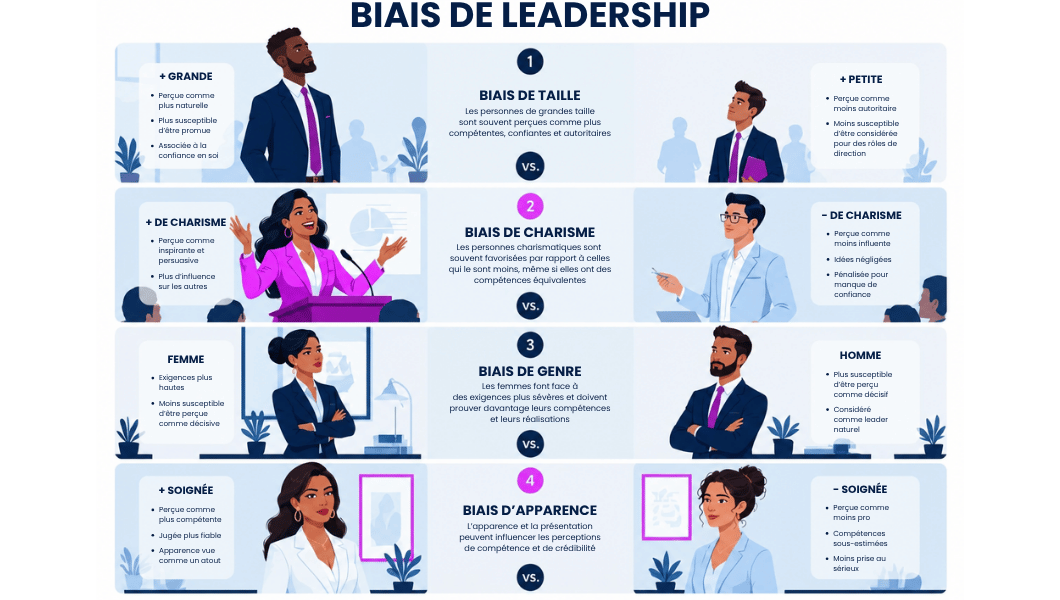
This is where things become particularly interesting. Because people do not only judge competence, they also judge signals:
- Height: in some people's minds, "taller means more leader-like".
- Charisma: often mistaken for competence.
- Gender: even today, the majority of leadership positions are still held by men.
- Attractiveness: the beauty bias* demonstrates that appearance influences perceptions of leadership potential.
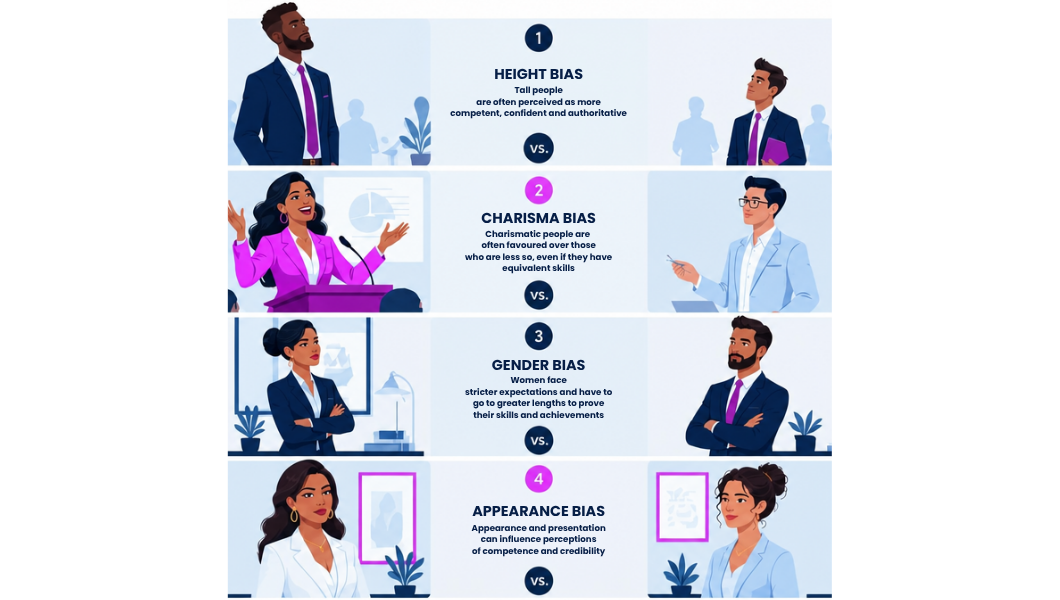
Leadership Biases (more detailed illustration available in the image gallery at the end of the article)
In other words, part of our image of the "perfect leader" is shaped by bias. And none of these characteristics guarantees actual leadership ability.
Not all leaders fit the stereotype of the charismatic executive either. For example, Tim Cook, Chief Executive Officer of Apple, is often described as a far more discreet and reserved leader than his predecessor.
And, just as a reminder, being attractive may open a few doors, but it will not help you manage a team of 50 people.
And what about astrology? A reliable source... almost
Let's be honest: no, your star sign will not make you a better manager. Companies do not recruit an Aquarius, they recruit a human being.
That said, if you want to play along, some articles identify Aries, Taurus and Gemini as the signs most commonly represented among business leaders.
A coincidence? Probably... but it makes for a good conversation starter at an after-work gathering!
More seriously, a good leader is also...
Not the person who knows everything, but the one who is willing to say, "I don't know, teach me." They do not have all the answers. The difference is that they acknowledge what they do not know and adapt accordingly.
Nor are they the person who does everything themselves, but the one who enables others to move forward. If their team is not progressing, the problem is not necessarily the team, it may be the leader. Leadership is relational, not merely personal.
Leadership is also influenced by culture. A leader in a Luxembourgish company will not necessarily lead in the same way as one in an American organisation. Context changes everything, whether it is a crisis, a particular era or a cultural environment.
And sometimes, all it takes is a meeting, a project or a crisis to change everything. Becoming a leader is a combination of hard work, opportunities, choices, relationships and chance.
Take Satya Nadella as an example. He transformed an entire corporate culture by placing empathy and collaboration at the heart of leadership.
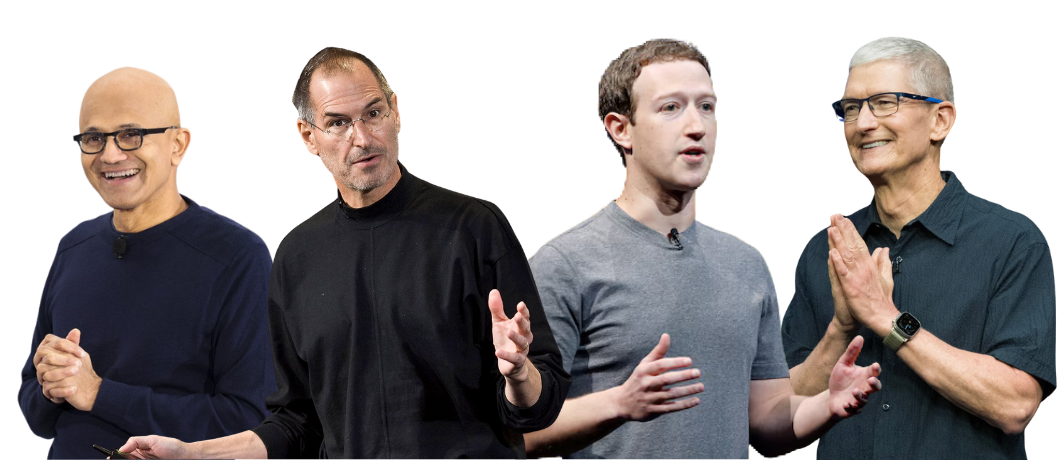
Satya Nadella, Steve Jobs, Mark Zuckerberg and Tim Cook
You can share these traits without being a leader
You do not need to be a CEO, director or manager to demonstrate leadership. You can have vision, motivate others and make decisions even without holding a formal title.
Many of the qualities found in successful leaders can also be found among:
- Junior professionals;
- Teams;
- Freelancers.
Leadership does not begin with a title. It begins with behaviours.
Looking to Develop Your Leadership Skills?
Discover hundreds of professional management training courses on Moovijob.com.
*Fortune 500: an annual ranking of the 500 largest American companies based on revenue.
*Beauty bias, also known as "pretty privilege": the tendency to attribute greater social or intellectual qualities, opportunities, leniency and positive attention to people perceived as attractive compared with those who are not.
.png)
.png)